When a senior dog can’t use the dog door anymore, they have relied on for years, the change can seem surprisingly sudden. Your dog may walk toward the entrance and stop, push their head through the flap but back away, get their front legs through and struggle to bring the hindquarters across, or simply begin waiting for you to open the regular door instead.
That does not necessarily mean your dog has forgotten how the dog door works. Using one requires a sequence of movements that is easy to overlook when a dog is younger. They have to approach on stable footing, position the head, push against the flap, lift each foot over the bottom edge, move through a confined opening and regain balance on the other side.
A relatively small change in strength, balance, flexibility, vision or confidence can make one part of that sequence considerably harder. Before replacing the dog door or trying to persuade your dog through it repeatedly watch one complete attempt. The point where the movement becomes difficult can tell you much more than the refusal itself.
Affiliate disclosure: This article contains affiliate links. If you make a purchase through one of these links, we may earn a commission at no additional cost to you.
First, Work Out Where Your Dog Is Struggling
Watch from a position where you can see your dog’s entire body. Pay particular attention to the feet and hindquarters rather than looking only at the flap.
A few patterns can help narrow down the problem:
- If your dog approaches but stops before touching the flap, the difficulty may involve the flap, visibility, footing or anticipation of an uncomfortable crossing.
- If the head goes through but the body does not follow, stepping over the bottom edge or moving through the opening may have become difficult.
- If the front legs get through but the hind legs struggle, pay close attention to step-over height and traction.
- If your dog gets through but slips or stumbles afterward, the landing area may be the main problem.
- If your dog comfortably walks through the regular door when you open it, compare what that larger doorway removes from the task.
These observations do not diagnose why your dog’s movement has changed. They simply help you identify which part of the dog-door setup needs attention.
Once you know where the difficulty occurs, these ten changes can help make the entrance easier and safer to use.
1. Improve Traction on Both Sides of the Dog Door
A dog door can be easy to fit through but difficult to use when the floor around it is slippery. Your dog needs enough traction to approach the opening, push against the flap, transfer weight between the legs and regain balance after coming through. Smooth tile, polished wood, wet decking or another slick surface can make those movements much harder for an older dog.
Pay particular attention to the hind feet. If they slide backward or gradually spread apart while your dog tries to push through, the dog may be using a considerable amount of effort simply to remain upright.
If you have noticed the same problem during meals, our guide to a senior dog’s back legs sliding while eating explains why secure footing matters when an older dog has to balance while performing another task.
For the dog-door area, traction should extend beyond one tiny mat placed immediately beside the opening. Your dog needs enough stable surface to approach, position all four feet, cross and land securely. Any mat or runner should stay flat, resist movement underfoot and avoid creating curled edges that become another obstacle. If you need to create a larger traction area around the entrance, you can see an example of a nonslip runner for an entryway on Amazon.
Outdoor surfaces also need to remain secure when wet. A solution that provides traction on a dry afternoon but becomes slippery after rain does not solve the problem reliably.
2. Check the Step-Over Height
The raised section at the bottom of a dog door is easy for caregivers to overlook because it may be only a few inches high. For an aging dog, however, that small lip can become the hardest part of the crossing. Each paw has to clear the bottom edge. An older dog who no longer lifts the hind feet as high, has reduced flexibility or finds weight transfer difficult may begin catching a paw even though walking across level ground remains relatively comfortable.
Watch whether your dog’s front feet clear the opening while one or both back feet drag or catch. Also notice whether your dog pauses with the front half of the body through the door while trying to bring the hindquarters forward. Compare both directions. The indoor and outdoor surfaces may be at different heights, making the step-over substantially harder in one direction.
Guidance for older dogs using pet doors recognizes that step-over height can become more difficult as mobility changes.
If the bottom edge is clearly causing difficulty, avoid placing a loose cushion, unstable box or makeshift platform beside it. Anything designed to reduce the height difference needs to remain secure when your dog’s full weight shifts onto it and should not introduce another edge that can catch a paw.
3. Check Whether the Flap Has Become Too Difficult to Push
Sometimes the obstacle is not underneath the dog but directly in front of them. Watch what happens when your dog’s head or shoulders contact the flap. A dog who pushes once and immediately retreats may be finding the resistance uncomfortable or difficult to overcome. One useful observation is whether your dog walks through more readily when the flap is safely held open. If that changes the behavior substantially, inspect the pet door itself.
Check whether the flap moves as the manufacturer intended and whether it has become stiff, damaged or misaligned. Magnets, weather seals and closing mechanisms vary between dog doors, so adjustments should follow the manufacturer’s instructions rather than disabling parts without understanding their purpose.
A dog who previously pushed through the same flap easily but suddenly finds the movement difficult may still need a veterinary check, particularly if you are seeing changes in the neck, shoulders, gait or general mobility. Making the flap easier to move can remove an obstacle, but it does not necessarily explain why that obstacle has suddenly become significant.
4. Make Sure the Opening Still Fits the Way Your Dog Moves
A dog door can remain technically large enough for your dog’s body while no longer providing enough space for comfortable movement. Older dogs may move more slowly and less flexibly through confined openings. A dog who once ducked, twisted and stepped through in one smooth movement may now need more clearance to complete the same sequence without losing balance.
Watch whether your dog has to crouch deeply, turn the shoulders or squeeze the hips through. Notice whether the back, hips or sides repeatedly touch the frame. If the opening appears restrictive, measure your dog according to the pet-door manufacturer’s sizing instructions before considering a replacement. Do not assume that simply buying the largest possible door is the answer; the position and step-over height matter alongside the width and height of the opening.
The goal is to determine whether the entrance still accommodates the way your dog moves today rather than the way they moved when the door was originally installed.
5. Improve Visibility Around the Entrance
If your senior dog can’t use dog door access confidently at certain times of day, look at the lighting around the entrance. Vision changes can make a familiar opening harder to judge, particularly when there is poor contrast between the flap, frame, wall and floor. A dog who uses the door during daylight but begins hesitating after dark is giving you useful information.
The American Kennel Club’s guidance on helping dogs with vision loss recommends maintaining a consistent home environment and using environmental cues to help dogs navigate safely. Keep the approach well-lit without creating harsh glare, particularly if your dog goes outside during the night. Avoid leaving unexpected objects beside the opening and keep the route predictable so the dog does not have to negotiate new obstacles immediately before or after passing through.
If hesitation at the dog door accompanies bumping into furniture, difficulty judging other steps or another noticeable vision change, arrange a veterinary examination rather than treating the entrance as an isolated problem.
6. Clear the Approach and Landing Areas
The few feet immediately before and after a dog door matter more than they may appear. An older dog needs enough room to approach relatively straight, position the body and continue moving after coming through. Furniture, plant pots, shoes, storage boxes or other objects close to the opening can force a dog to turn while also negotiating the flap and step-over.
Outside, look at where the paws land. Uneven paving, loose gravel, mud, a steep drop or a narrow landing can make the crossing harder even when the door itself is suitable. Keep both sides clear enough for your dog to complete the entire movement before needing to turn.
This becomes especially important for dogs who are beginning to have difficulty navigating confined spaces. Our guide to what to do when a senior dog gets stuck behind furniture at night explains how simplifying frequently used routes can reduce opportunities for an older dog to become trapped or disoriented.
Think of the dog door as a short route rather than a single opening. Your dog has to manage the approach, crossing and departure safely for the setup to work.
7. Compare the Dog Door With the Regular Doorway
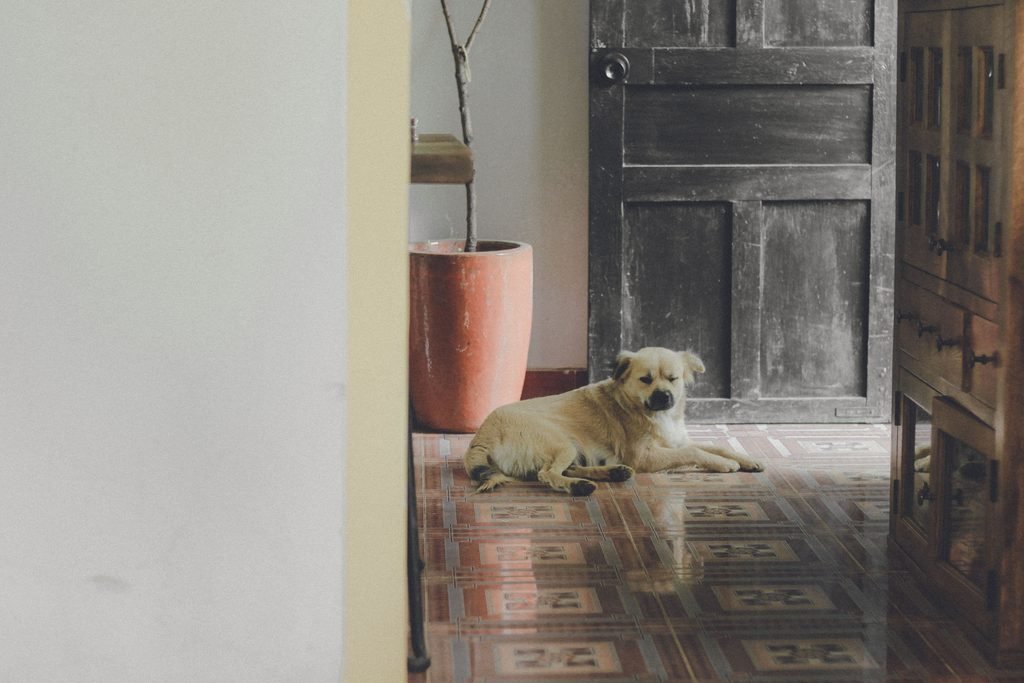
Opening the regular door can provide a useful comparison. If your dog confidently walks through the full-size doorway but refuses the dog door beside it, look at what the larger entrance removes from the task. There may be no flap to push, no narrow frame to negotiate and little or no raised edge to step over.
You can also compare body movement. Does your dog lift the feet normally through the regular doorway? Do they hesitate at an ordinary threshold? Are they comfortable stepping from the indoor floor onto the outdoor surface? If your dog also struggles with the regular doorway, the problem is less likely to be limited to the pet door.
That distinction can prevent you from repeatedly modifying an entrance when your dog is actually showing a broader change in mobility. Difficulty crossing small thresholds, stepping onto different surfaces or negotiating minor changes in floor height may deserve a wider look at how easily your dog is moving around the home.
8. Consider a Properly Designed Step or Ramp When Appropriate
A dog door installed above ground level can become increasingly difficult to use as a dog ages. A properly designed step, platform or ramp may help some dogs manage a height difference, but adding one automatically is not always the right answer. The safest solution depends on the dog’s size, mobility and the physical layout around the entrance.
A steep ramp can be harder to negotiate than the original step. A narrow platform may not provide enough room to stabilize. Smooth materials can become slippery, and an unsecured structure can move when the dog transfers weight onto it.
Identify the movement you are trying to improve before adding equipment. If the outdoor landing is significantly lower than the indoor floor, a stable transition may help. If your dog is actually struggling with the flap or confined opening, a ramp will not address the underlying obstacle. If a ramp is appropriate for your dog’s situation, you can see an example of an adjustable dog ramp with a nonslip walking surface on Amazon.
For a dog with substantial mobility limitations, ask your veterinarian or a qualified canine rehabilitation professional about an appropriate setup. Ramp incline, width, traction and landing space need to suit the individual dog rather than being chosen solely because the product is marketed for senior pets.
9. Make the Return Journey as Easy as Going Out
A dog door is only useful for independent access if your dog can safely travel in both directions. Stand on each side and look at the entrance from your dog’s perspective. The step-over height, lighting, footing and available landing space may be very different depending on which direction the dog is traveling.
For example, going outside may involve stepping slightly downward onto a large patio, while returning requires pushing the flap and lifting the hind feet upward from a lower surface. A dog can therefore appear to use the pet door successfully when leaving but become stranded outside because coming back is substantially harder.
Observe both journeys rather than assuming one successful crossing proves the setup is suitable. This is particularly important if your dog goes outside independently at night or while nobody is watching. A senior dog who can leave the house but cannot reliably return through the same entrance no longer has genuinely independent access.
If you make a modification, test whether it improves both directions. Solving one side of the crossing while making the other more difficult simply moves the problem.
10. Retire the Dog Door if Independent Access Is No Longer Safe
Sometimes the most useful change is deciding that your dog no longer needs to use the dog door independently. For some senior dogs, improving traction, reducing an awkward height difference or addressing another simple obstacle can make the entrance comfortable again. For others, changes in mobility, vision or awareness eventually make unsupervised access less appropriate.
Consider what happens beyond the opening as well as the crossing itself. Your dog needs to be able to move safely around the outdoor area, find the entrance again and return without becoming stuck, falling or waiting outside because the journey back has become too difficult.
Closing the dog door and taking your senior dog outside yourself is not a failure to preserve independence. Supervised toilet trips may simply become the safer version of a routine that previously required no assistance. If balance during urination has also become difficult, our guide to a senior dog that falls over when peeing explains how to make those potty trips safer while you arrange appropriate veterinary assessment.
The transition can also give you useful opportunities to observe mobility, toileting and behavior that were previously happening outside without you seeing them. If accidents are also becoming more common as your dog’s toileting routine changes, see our guide to keeping an incontinent senior dog clean between baths.
If the dog door has become a place where your dog repeatedly struggles, stumbles or gets stuck, continuing to expect independent use may offer little benefit simply because it was once part of the dog’s normal routine.
Don’t Force Your Dog Through the Door
When a dog who has used the same entrance thousands of times suddenly refuses it, repeatedly calling them through with treats can seem like the obvious way to rebuild confidence.
First make sure the crossing is physically comfortable. Gentle encouragement may be useful after a genuinely safe modification, but pushing or pulling a reluctant senior dog through a small opening can increase the risk of a fall and may make the entrance more stressful.
If your dog approaches and repeatedly backs away, treat the hesitation as information. Check the flap, footing, opening, step-over and landing before assuming the behavior needs retraining. This distinction is particularly important when the refusal is new. A dog who hesitates because a movement hurts or feels unstable is unlikely to benefit from being repeatedly persuaded to perform that same movement.
When the Change Deserves a Veterinary Check
If your senior dog can’t use dog door access they previously managed comfortably, particularly when the change appeared suddenly or continues to worsen, tell your veterinarian. The dog door may simply be the first place where a wider mobility change becomes obvious. You might also begin noticing difficulty getting up from the floor, climbing a small step, walking on smooth surfaces, standing through a meal or getting into the car.
If your dog can still walk around reasonably well but now struggles when required to remain upright in one place, our guide to a senior dog that can walk but can’t stand still for long covers that specific mobility pattern.
VCA’s guidance on behavior changes and pain in aging dogs explains that changes in movement and everyday behavior can be associated with pain in older dogs. Reluctance to perform previously normal activities, difficulty rising and changes in posture or mobility deserve attention rather than being automatically attributed to age.
Arrange veterinary advice if the dog-door difficulty occurs alongside limping, weakness, repeated stumbling, dragging or catching the feet, obvious discomfort, difficulty getting up, significant changes in coordination or another new physical or behavioral change.
A sudden inability to stand or walk normally, collapse, severe weakness, significant breathing difficulty or another acute deterioration requires prompt veterinary attention rather than experimentation with home modifications.
When you speak with your veterinarian, describe what happens during the crossing. Saying, “She won’t use the dog door anymore” is useful, but saying, “She puts her head and front legs through, then her back feet repeatedly catch on the bottom edge” provides considerably more information.
A Quick Check Before Your Senior Dog Uses the Door Again
Once you have made any appropriate changes, watch another complete crossing and check five things: whether your dog approaches willingly, whether all four feet remain secure, whether the body clears the opening comfortably, whether the landing is controlled and whether the return journey is equally manageable.
The goal is not simply to get your dog through the opening once. The entrance should be comfortable and repeatable enough that your dog does not need to struggle every time they want to go outside. When a senior dog can’t use dog door access that once seemed effortless, the answer is rarely to expect them to keep moving exactly as they did when they were younger. The better approach is to identify which part of the entrance no longer matches their current abilities.
For one dog, that may mean better traction. For another, it may be an awkward step-over, difficult flap, poor lighting or an opening that no longer provides enough comfortable clearance. Some dogs may benefit from a properly designed transition, while others will be safer retiring the dog door and going outside with their caregiver.
The dog door is there to make access easier. Once it requires your senior dog to struggle, stumble or force their body through an uncomfortable movement, the entrance should adapt to the dog you have now.