If your senior dog falls over when peeing, getting outside may not be the difficult part. Your dog might walk to the usual toilet area normally, begin to urinate, and then wobble, stumble sideways, sit down suddenly, or lose their balance completely while trying to hold the position.
That is a more specific problem than general weakness or urinary incontinence. Urinating while standing, squatting, or lifting a leg requires a dog to shift weight and maintain a particular body position for several seconds. An older dog may manage ordinary walking reasonably well but become much less stable when that weight distribution changes.
Repeatedly falling during urination should be discussed with your veterinarian rather than accepted as an unavoidable part of aging. At home, however, there are useful things you can do immediately: watch exactly where the movement becomes difficult, improve the toilet area’s footing, reduce unnecessary obstacles, and make each trip easier while the underlying change is being assessed.
What Does It Look Like When a Senior Dog Falls Over When Peeing?
Watch the entire toilet trip rather than only the moment your dog loses balance. The sequence can tell you much more about what has changed.
Your dog may walk outside comfortably and only become unstable after beginning to urinate. Another dog may hesitate before assuming the usual position, repeatedly reposition the feet, or abandon a leg lift and switch to a different posture.
Look for details such as:
- whether your dog is stable while walking to the toilet area;
- whether the wobbling begins only after lifting a leg or beginning to squat;
- whether one back leg repeatedly slips or buckles;
- whether your dog suddenly sits down during urination;
- whether your dog starts walking before finishing;
- whether urine gets onto the legs, belly, or coat because the normal position cannot be maintained;
- whether the problem is worse on wet grass, paving, decking, tile, or another particular surface; and
- whether your dog can get back up independently after losing balance.
These details are more useful than simply reporting that your dog “fell while outside.” They help separate a posture-specific problem from a broader loss of balance or strength.
It is also useful to compare what happens during bowel movements. If your dog becomes unstable while holding that posture too, our guide to a senior dog that falls over when pooping covers that related problem and the practical changes that can make those toilet trips safer.
Notice Whether Your Dog Has Changed How They Pee
A change in urination posture can appear before a complete fall.
A male dog that lifted one back leg throughout adulthood may begin lifting it only slightly, touching it down before finishing, or choosing to squat instead. A dog that previously held a steady squat may start widening the feet, shifting repeatedly, walking while urinating, or lowering the rear end much closer to the ground.
The American Kennel Club notes that older arthritic dogs may stop lifting a leg and squat instead because lifting the leg has become physically uncomfortable.
VCA Animal Hospitals also identifies walking while urinating or defecating rather than maintaining the normal posture as a behavior that can be associated with pain in aging dogs.
That does not mean a posture change proves that your dog has arthritis or any other particular condition. It means the change is worth noticing and reporting rather than assuming your dog has simply developed a new bathroom habit.
Check the Ground Where Your Dog Usually Pees
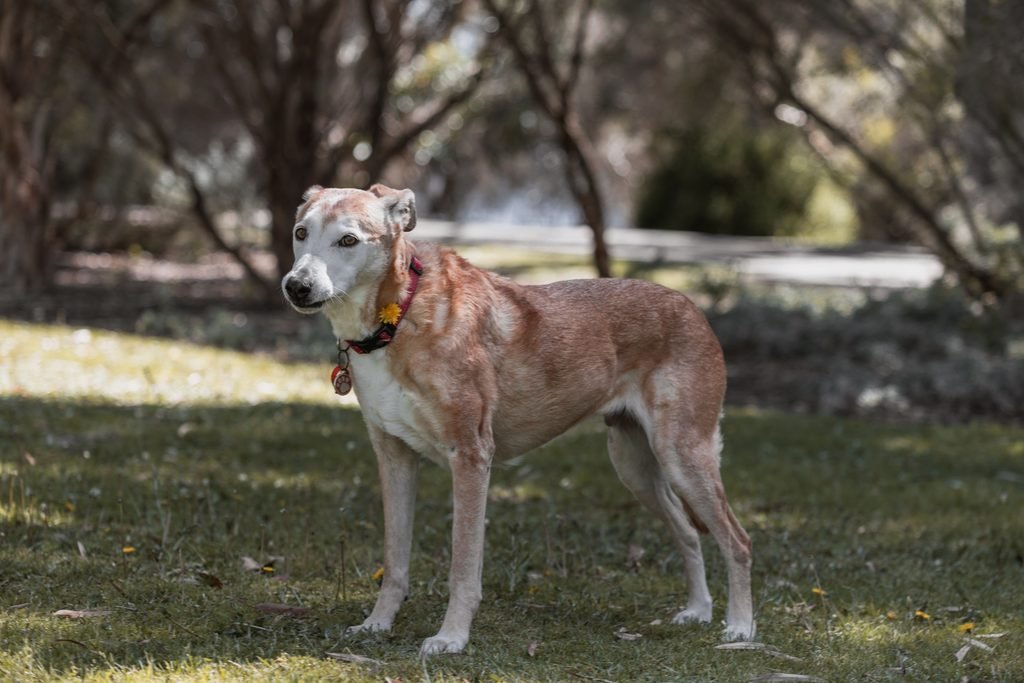
A toilet area that worked perfectly for years may become difficult once balance or mobility changes. Start by looking at the surface beneath all four feet. Wet grass can be slick. Mud can shift. Loose gravel may move under the paws. Steep or uneven ground can require constant adjustments in weight. Smooth patios, decks, and paving may also become slippery when wet.
If your senior dog falls over when peeing in one area but appears more stable elsewhere, footing may be contributing to the problem even if it is not the underlying cause.
Where possible, choose a toilet area that is:
- reasonably level;
- easy to reach;
- free from clutter and obstacles;
- not excessively slippery when wet;
- large enough for your dog to position themselves comfortably; and
- close enough that your dog is not exhausted before beginning to urinate.
The American Animal Hospital Association recommends environmental modifications for senior pets with mobility limitations, including rugs or yoga mats for better footing and appropriately fitted supportive equipment where needed.
Outdoors, the exact solution depends on the surface. The goal is not to create an elaborate new bathroom area immediately. Start by removing avoidable instability from the route and the place your dog already prefers to use.
Make the Route to the Toilet Area Easier
Sometimes the urination posture is only the final difficult movement in a much longer sequence.
Think about everything your dog has to do first: rise from bed, cross the house, reach the door, negotiate a threshold or dog door, use steps, cross a patio, and walk to the toilet area. A senior dog that reaches the destination already tired or unstable may have less ability to maintain balance once they begin to urinate.
Reduce unnecessary effort where you can. Keep the route clear, add secure traction to slippery indoor sections, and avoid making your dog travel farther than necessary just to reach an acceptable bathroom spot.
If the dog door itself has become difficult, our guide to a senior dog that can’t use the dog door anymore covers that obstacle separately.
For some dogs with significant mobility limitations, an accessible toilet option closer to the house may eventually make sense. The American Kennel Club explains that indoor potty areas can sometimes help senior dogs when arthritis, mobility limitations, illness, or reduced bladder control make outdoor trips difficult.
Don’t Force Your Dog Into Their Old Peeing Position
If your male dog no longer wants to lift a leg, don’t repeatedly encourage him to do so. Likewise, don’t try to position a dog’s legs into the squat they used when they were younger.
Your dog may already be choosing a different posture because it feels more secure. The useful question isn’t whether the new position looks normal. It is whether your dog can urinate comfortably and safely, and whether the change represents something your veterinarian should assess.
If your dog starts squatting instead of lifting a leg but remains stable and empties the bladder normally, note the change. If your dog repeatedly attempts different positions, strains, produces little or no urine, cries, or cannot remain upright, the situation needs more urgent attention.
Be Careful About Physically Holding Your Dog Up

When a dog begins to tip over, the instinct is to grab them. But supporting a dog during urination can be awkward, particularly if you are trying to hold the abdomen, hips, or back legs while the dog is already shifting position. Don’t improvise by pulling upward on a collar, lifting a leg into position, or tightly wrapping something around the abdomen.
If your dog needs regular physical assistance to toilet, ask your veterinarian or veterinary rehabilitation professional to show you an appropriate support method for your dog’s particular mobility problem. A properly fitted mobility harness or sling may help some dogs, but fit and placement matter.
AAHA includes harnesses and slings among possible lifestyle modifications for mobility-compromised senior pets, alongside nonslip flooring, ramps, and other environmental changes. The objective is to support your dog safely and not simply keep them upright by any means possible.
Watch Whether the Problem Is Limited to Peeing
A senior dog that falls over when peeing may also be showing smaller balance changes elsewhere that are easier to overlook.
Watch your dog during ordinary movements over the next few days. Are they still steady while walking? Can they remain standing without swaying? Do they stumble while turning? Have they started struggling to rise? Are the back feet sliding apart on smooth floors?
If your dog walks reasonably well but becomes unstable only when required to hold a stationary posture, our guide to a senior dog that can walk but can’t stand still for long explains that movement pattern in more detail.
If instability is appearing during several unrelated activities, tell your veterinarian that the problem is broader than urination. That is more informative than treating each fall as a separate accident.
Don’t Confuse Falling While Peeing With Urinary Incontinence
It is good to know the difference. Incontinence generally refers to loss of voluntary urinary control. A dog may leak while sleeping, dribble urine while moving, or appear unaware that urine is escaping. That is different from a dog that deliberately walks to a toilet area, consciously begins to urinate, and then loses physical stability while maintaining the position.
The two problems can also occur together, so don’t assume one excludes the other. Senior dogs can experience changes involving mobility and urinary function at the same time.
Tell your veterinarian if you have noticed leaking during sleep, unusually frequent urination, increased thirst, blood in the urine, repeated attempts to pee, straining, or a sudden increase in indoor accidents. Those observations change the picture considerably.
Keep Your Dog Clean if They Fall Into Their Urine
A dog that falls sideways or sits down before finishing may get urine on the back legs, belly, tail, or surrounding coat. If this happens repeatedly, don’t leave the pee on the skin and fur until the next full bath.
Gently clean the pee and dry your dog thoroughly. Pay particular attention to skin folds and areas where damp fur remains against the skin.
If keeping your dog clean between full baths is becoming a regular part of care, our guide to keeping an incontinent senior dog clean between baths includes a practical cleaning routine that can also be useful when mobility-related accidents leave urine on the coat.
Contact your veterinarian if the skin becomes red, sore, develops an odor, or shows other signs of irritation.
Record the Posture Instead of Trying to Recreate It
The problem may not happen during a veterinary appointment. Your dog may also move differently on a clinic floor or when excited, nervous, or being handled.
If your dog naturally begins to urinate and you can safely record the movement without distracting them, a short video can be useful. Film from far enough away that your presence does not change the dog’s position.
Try to capture the approach, the beginning of the posture, the point where balance changes, and the recovery afterward. AAHA’s senior-care guidelines specifically identify caregiver videos of pets moving in their normal environment as useful tools for assessing mobility, movement, and musculoskeletal pain.
Do not repeatedly take your dog outside or try extra urination attempts just to get a better video. Record the problem when it happens naturally.
When Does Falling While Peeing Need Veterinary Attention?
A new or worsening change in urination posture should be discussed with your veterinarian, particularly when your dog is actually losing balance. Aging alone should not be used as the explanation for a loss of physical function.
The American Kennel Club includes difficulty posturing to urinate or defecate among possible signs of osteoarthritis, while emphasizing that dogs showing possible signs should be evaluated by a veterinarian.
Contact your veterinarian promptly if the change is persistent or worsening. Seek urgent veterinary advice if your dog:
- repeatedly attempts to urinate but produces little or no urine;
- appears unable to urinate;
- has blood in the urine;
- cries or shows obvious pain while urinating;
- suddenly develops severe weakness or cannot stand;
- begins dragging or knuckling a paw;
- has a sudden major loss of balance;
- collapses or loses consciousness;
- develops sudden loss of bladder control together with a major mobility change; or
- cannot get back up after falling.
Difficulty maintaining the posture can occur alongside musculoskeletal problems, but urinary, neurologic, and other medical conditions can also change how an older dog urinates. Your veterinarian needs the complete pattern rather than an assumed cause.
Make Every Potty Trip Require Less Effort
If your senior dog falls over when peeing, don’t concentrate only on stopping the fall. Look at the entire bathroom routine. Can your dog reach the toilet area without exhausting themselves? Is the ground stable? Is there enough room to position all four feet? Has their normal leg-lifting or squatting posture changed? Are they also becoming unstable during other movements?
Small home adjustments can make an immediate difference. A closer toilet area, a clearer route, secure footing, and fewer steps or obstacles may reduce the physical demands of something your dog has to do several times every day.
At the same time, repeated falling deserves veterinary assessment. The safest approach combines both responsibilities: make today’s toilet trips easier and safer while giving your veterinarian clear observations about what has changed.
Your senior dog does not need to pee exactly the way they did when they were younger. They do need a bathroom routine that their changing body can manage safely and comfortably.