If your senior dog has trouble lying down, you may notice that settling has become a process rather than one smooth movement. Your dog might stand beside the bed for longer than usual, reposition their feet several times, lower partway and stand again, or drop the last few inches instead of easing themselves gently onto the floor.
That change is worth paying attention to. Lowering from a standing position requires your dog to shift weight, bend several joints, maintain balance, and control the descent toward the floor. An older dog may still walk around the house reasonably well while finding this particular transition increasingly difficult.
The goal at home is not to diagnose why the movement has changed. Instead, watch exactly where your dog struggles, make the resting area easier to use, improve traction around it, reduce unnecessary repeated transitions, and share new or worsening mobility changes with your veterinarian.
What Does It Look Like When a Senior Dog Has Trouble Lying Down?
The most useful observation is what happens between standing normally and becoming fully settled. Some dogs hesitate before beginning the movement, while others start lowering and appear unable to control the final part of the descent. You may also see repeated attempts to position the legs before the dog finally lies down.
The American Animal Hospital Association identifies changes in the way a pet stands, sits, or lies down as possible signs of pain. These can include struggling to transition between positions or dropping into a lying position instead of lowering gradually. When you notice the problem, watch for a consistent pattern rather than concentrating on a single awkward movement. Useful details include:
- whether your dog hesitates before starting to lower their body;
- whether the front or back end appears more difficult to lower;
- whether one leg is repeatedly repositioned before lying down;
- whether the feet slide as your dog begins to lower;
- whether your dog lowers slowly at first and then suddenly drops;
- whether they stand back up immediately and try again;
- whether the difficulty changes between carpet, hard flooring, and their usual bed; and
- whether the problem is becoming more frequent or pronounced.
A short video can be particularly helpful because your veterinarian may not see the same movement during an appointment. AAHA’s senior-care guidance notes that videos of pets moving in their normal environment can provide useful information when assessing mobility and musculoskeletal pain.
Check the Floor Around Your Dog’s Resting Area
If your senior dog has trouble lying down, look closely at the feet during the first part of the movement. A dog needs enough grip to control the transition from standing to the floor. When the paws slide on hardwood, laminate, tile, or another smooth surface, lowering can become less stable.
This may be subtle. Your dog does not have to fall for traction to be a problem. The front feet may creep forward as the elbows bend, or the back feet may slide outward while the hindquarters lower. That movement can make an already demanding transition harder to control. If sliding feet are also showing up during other stationary activities, our guide to a senior dog’s back legs sliding while eating explains how traction can affect an older dog’s ability to maintain a stable stance.
VCA Animal Hospitals recommends nonslip rugs and runners for mobility-compromised dogs on hard flooring. Around a resting area, the important point is to provide secure footing where your dog approaches, turns, stands, lowers themselves, and eventually gets back up.
A nonslip runner or secured mat may be enough if the bed itself is comfortable but the surrounding floor is slick. Avoid loose rugs that move under your dog’s weight or have raised edges that can catch a paw. The solution should make the transition more predictable rather than introducing another obstacle.
Look at the Bed, Not Just the Dog
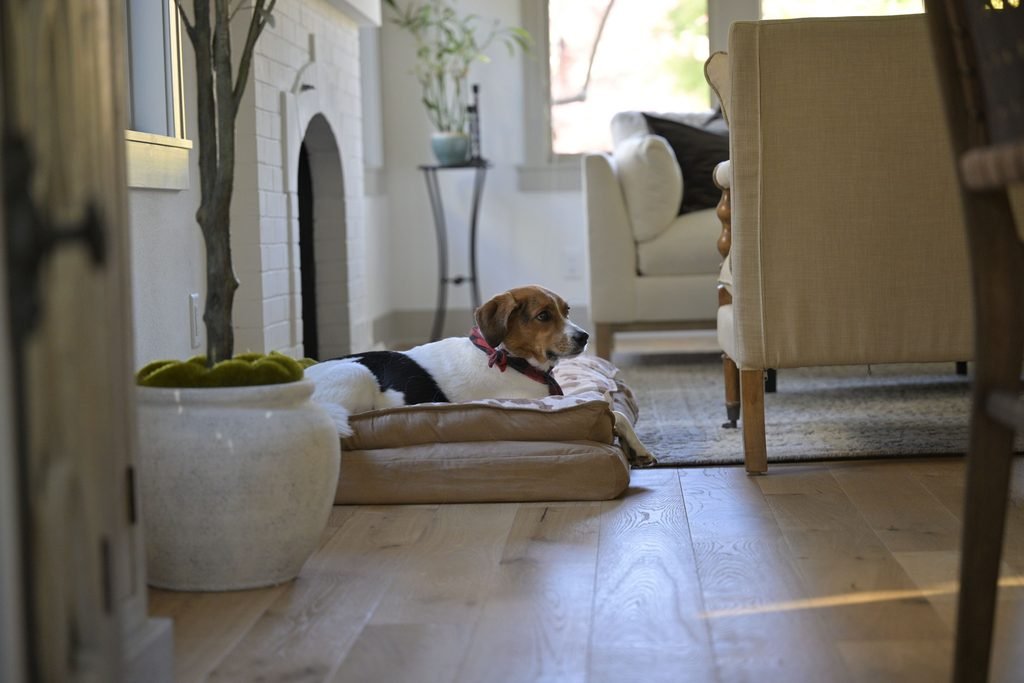
A bed that worked well several years ago may no longer suit the way an older dog moves. Very high sides can require an extra step before settling, while an unstable or excessively soft surface can move underneath the dog’s feet as they try to position themselves.
The bed should be easy to approach and should not require your dog to climb over a large edge simply to lie down. VCA’s guidance for mobility-compromised dogs recommends bedding that dogs do not have to climb over or onto and notes that a recessed orthopedic design may be useful for dogs with reduced mobility.
When evaluating your dog’s current bed, concentrate on practical details:
- Entry: Can your dog step into the resting area without lifting the legs unusually high?
- Stability: Does the bed remain in place when your dog turns and begins lowering?
- Support: Does the sleeping surface support your dog without collapsing deeply underneath them?
- Space: Is there enough room for your dog to reposition their body without repeatedly stepping off the bed?
- Exit: Can your dog reach secure flooring when they stand again?
You do not need to replace a bed simply because your dog is older. Watch your dog use it first. If they lower themselves comfortably on one surface but repeatedly struggle on another, that comparison gives you useful information about whether the resting setup is contributing to the problem.
If the bed is also making the opposite transition difficult, our guide to a senior dog that sinks into their bed and struggles to get up explains how mattress support, entry height, traction, and the surrounding floor can affect rising after rest.
Separate Difficulty Lying Down From Difficulty Standing Still
Several senior-dog mobility problems can look similar unless you watch the entire movement. A dog that remains standing because lowering is difficult has a different problem from a dog that becomes shaky simply because they have been standing in one place too long.
If your dog is comfortable lowering themselves but becomes unstable whenever they have to remain upright, our guide to a senior dog that can walk but can’t stand still for long covers that pattern in more detail.
Likewise, difficulty getting comfortable should not automatically be treated as a sleep problem. The important question for this article is whether the physical transition into the lying position has changed. A dog may still sleep normally once settled but have increasing difficulty getting their body down comfortably in the first place.
Reduce Unnecessary Up-and-Down Transitions
If your senior dog has trouble lying down, repeatedly asking them to get up and settle again can add unnecessary work to the day. Look at where your dog naturally wants to spend time and consider whether their resting area is positioned conveniently for normal household life.
A dog that wants to remain near the family may repeatedly get up if their only supportive bed is isolated in another room. Similarly, moving a dog every time they settle because the bed blocks a walkway can create avoidable transitions. A practical resting area should allow your dog to stay involved without constantly needing to relocate.
This does not mean encouraging an older dog to remain in one position all day. Normal movement remains important, and your veterinarian can advise you about appropriate activity for your individual dog. The aim is simply to remove needless repetitions of a movement that has clearly become difficult.
Don’t Pull Your Dog Down Into Position

When an older dog remains standing beside a bed or seems unable to finish lowering themselves, it can be tempting to guide the hips downward or physically place the dog onto the bed. Unless a veterinary professional has shown you a safe assistance technique for your dog’s condition, avoid forcing the body into a lying position.
The hesitation may be telling you that a particular movement is uncomfortable or difficult. Pulling or pushing the dog through that movement does not address the reason for the hesitation and may make an unstable transition harder to control.
If your dog needs regular physical help changing positions, ask your veterinarian or veterinary rehabilitation professional whether a properly fitted support harness or another mobility aid would be appropriate. AAHA’s senior pain-management guidance includes fitted, padded harnesses among the home modifications that may help some senior pets with mobility limitations.
Notice What Happens After Your Dog Lies Down
The movement into the resting position is only part of the observation. Once your dog is down, notice whether they relax or continue trying to reposition themselves. A dog that lies down and settles comfortably presents a different pattern from one that repeatedly gets up, circles, lowers again, and still cannot become comfortable.
The American Kennel Club notes that senior dogs with arthritis or other painful conditions can have difficulty finding a comfortable sleeping position. Persistent inability to become comfortable therefore deserves veterinary attention rather than simply being treated as an inconvenient sleep habit.
Also notice whether the difficulty is limited to lying down. If your dog struggles when rising again, slides during other activities, or shows broader changes in walking and balance, tell your veterinarian about the entire pattern rather than focusing on a single movement.
When Should You Call Your Veterinarian?
A senior dog that has trouble lying down should be evaluated when the change is new, persistent, or becoming more noticeable. Difficulty lowering the body can occur with pain and mobility problems, but the cause cannot be determined reliably by watching the movement at home. AAHA’s guidance on senior-pet health problems specifically lists difficulty rising or lying down among changes associated with arthritis and recommends veterinary care when owners notice changes in how an older pet stands or moves.
Contact your veterinarian promptly if the difficulty lying down is accompanied by:
- a sudden or substantial change in mobility;
- crying, yelping, trembling, or other signs of distress during movement;
- repeated falling or collapsing;
- dragging, knuckling, or a marked change in coordination;
- an inability to get comfortable after lying down;
- difficulty getting back up once settled;
- a significant change in breathing while resting or trying to lie down; or
- other new changes in appetite, behavior, toileting, or normal activity.
Your veterinarian can consider the whole dog rather than assuming the change is simply part of aging. Depending on what they find, they may assess joints, muscles, the spine, neurologic function, general health, and other possible contributors to the change in movement.
Make Lying Down Easier Without Guessing at the Cause
When your senior dog has trouble lying down, the most useful home changes are often the simplest ones: secure the footing around the resting area, make sure the bed is easy to enter, remove unnecessary obstacles, and reduce repeated transitions that serve no practical purpose.
At the same time, avoid assuming that a new movement problem is merely old age. VCA Animal Hospitals specifically identifies difficulty easing into a sitting or lying position as a behavior change that can indicate pain in an aging dog.
Watch the movement carefully and record what changes. If your dog walks to the bed normally but hesitates, slides, drops suddenly, or repeatedly abandons the attempt once they begin lowering themselves, those details are useful. Combined with an easier home setup and appropriate veterinary assessment, they can help you respond to the particular movement your aging dog is finding difficult rather than treating every mobility change as the same problem.